Indoor-cat enrichment means arranging the home so a cat can rest safely, climb, scratch, explore, play, eat and avoid conflict in ways that suit feline behavior. It does not require a room full of expensive equipment. A stable perch, predictable hiding place, appropriate scratching surface and regular interactive play may be more useful than a large collection of rarely used toys. The Ohio State University Indoor Pet Initiative recommends evaluating the whole environment, especially access to resources and a cat’s ability to choose where and how to use them.
Start by watching your cat, not by shopping
Before buying another cat tree, spend a few ordinary days noticing what your cat already seeks out. Some cats watch birds from a windowsill; others prefer enclosed resting places, floor-level games or access to a quiet room. Watch when the cat chooses company and when it leaves. Note where scratching occurs and whether it is usually horizontal or vertical. Record where the cat waits for food, hides from visitors or hesitates to pass another household pet. These are clues about the environment, not proof that your cat has a behavioral disorder.
The Indoor Pet Initiative at Ohio State organizes feline needs around practical resources and the opportunity to perform natural behaviors. Its guidance covers litter boxes, scratching, perches, resting areas, toys and safe refuge. The strongest enrichment plan addresses missing choices. A cat that avoids a shared hallway may need another route or perch more than an additional toy. A nervous cat may benefit from a safe retreat instead of constant stimulation. Treat your first purchases as experiments: observe whether the cat uses them and adjust without taking avoidance personally.
Give height a purpose
Cats often value elevated vantage points because they offer opportunities to observe and rest away from household traffic. A sturdy shelf, secured window perch or stable climbing structure can create that option, provided it is suited to the cat’s age, weight and mobility. The location matters. A beautiful tower placed beside a loud appliance may be ignored, while a modest perch near a familiar window may become a favorite. Avoid placing furniture where a fall would be dangerous or where an open window is unsecured.
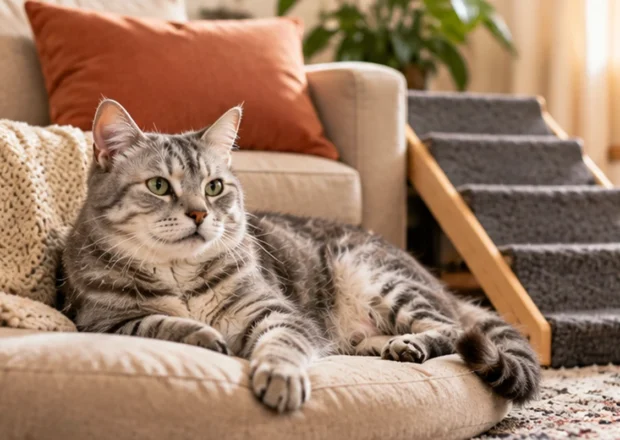
Vertical space is not the same as forcing a cat to climb. Older cats, kittens and cats with mobility problems may need lower platforms, ramps or intermediate steps. An indoor cat can enjoy choice at multiple heights. Provide a route down that does not require a dramatic jump, and consider whether other pets might block access. Multiple stable destinations are often more flexible than one tall piece of furniture. Watch how the cat moves through the setup; hesitant jumping, slipping or newly avoiding familiar heights can be reasons to ask a veterinarian about discomfort.
Scratching is a need, not a character flaw
Scratching helps cats express normal behavior, and the household’s task is to make appropriate options appealing. Put a stable vertical post or horizontal scratcher near a location your cat already uses, such as a favored resting area or a sofa corner. Texture and position matter: some cats prefer cardboard, others sisal or a different surface. An unstable post that wobbles during use may be rejected. Protecting furniture generally works better when an attractive alternative is nearby than when the cat is punished for scratching.
If the cat consistently returns to a particular piece of furniture, ask what that site offers. It may be along a travel route, beside a social area or near a sleeping spot. Move the scratching option toward the behavior rather than insisting the cat adopt your preferred corner. Positive reinforcement and patient adjustment are more useful than frightening the animal. Declawing is not an environmental enrichment solution. Sudden changes in scratching or grooming can also accompany stress or medical discomfort, so a sharp shift deserves a broader look.
Play should imitate a sequence, not random noise
Interactive play can let a cat stalk, chase, pounce and capture an appropriately safe toy. Use wand toys or other supervised activities in short sessions appropriate to the cat’s interest and stamina. A toy that moves predictably across the floor may hold attention better than one waved continually in the cat’s face. Let the cat succeed at catching it. Change the route and pace to create variety, and end before the animal becomes overexcited or exhausted. Store string-like toys safely when you cannot supervise them.
Different cats favor different play patterns. One may hunt low along the carpet; another may wait behind a chair and ambush. Rotate a small number of safe toys rather than leaving every toy out at once. Inspect items for loose parts and choking or entanglement hazards. Interactive games are not a substitute for medical evaluation if a normally playful cat becomes inactive, withdrawn or painful. Enrichment is most useful when it supports a healthy animal’s behavior and helps you notice when that behavior changes.
Turn some meals into exploration
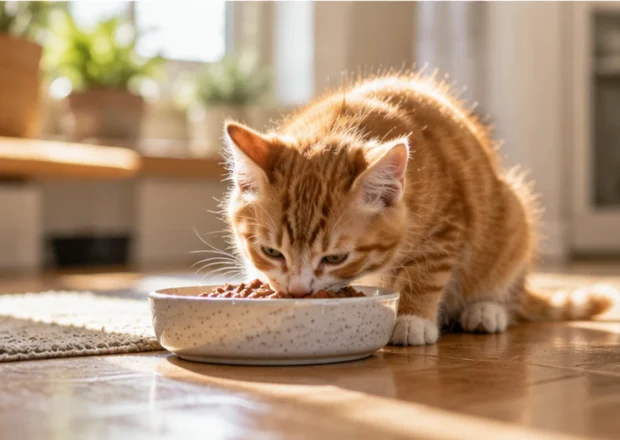
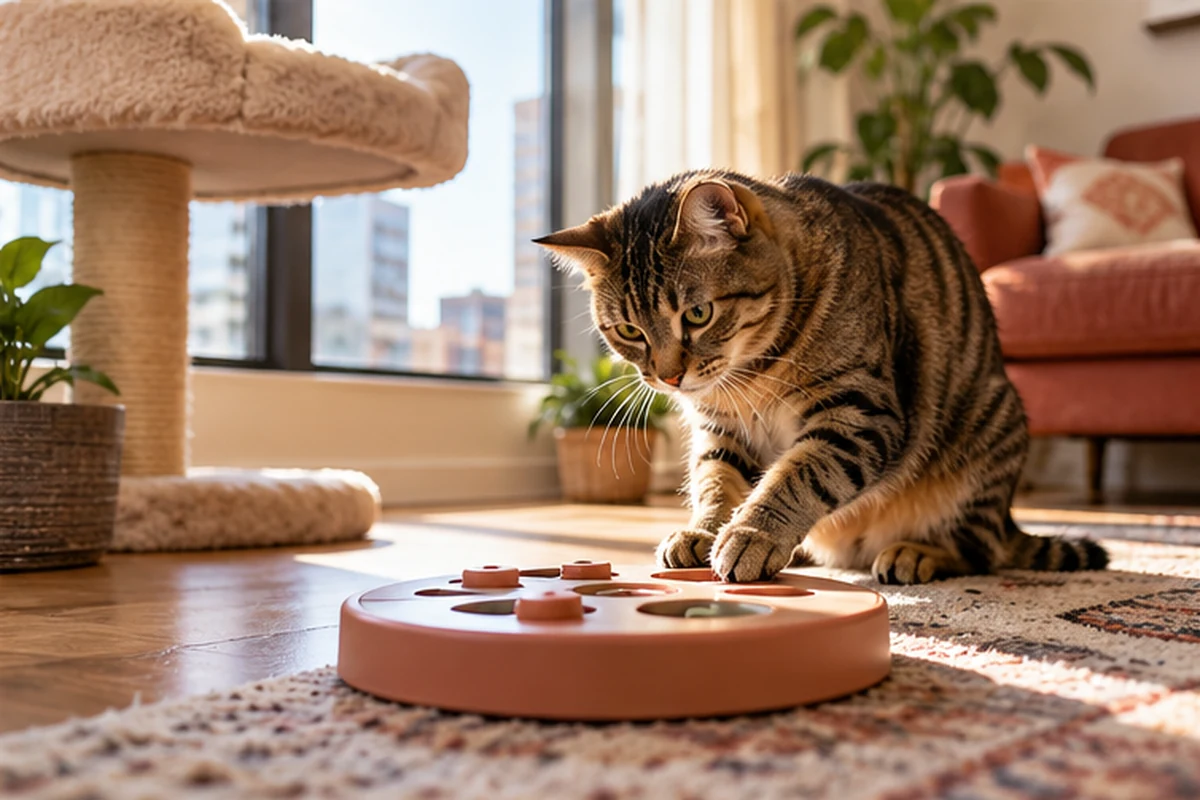
Food puzzles and foraging arrangements can add activity to eating for cats that enjoy them. Ohio State’s indoor-cat resources discuss food-based enrichment and feeding choices. Begin with an easy puzzle that reliably releases a small part of the cat’s ordinary ration, then increase difficulty gradually only if the cat remains interested. The aim is not to make food hard to obtain or to frustrate a cat with a medical condition. Always maintain access to appropriate meals and water as recommended for that individual animal.
For a cat that eats too quickly, a veterinarian may have suggestions about feeding tools, portion distribution or evaluation for underlying concerns. For a cat on a prescription diet, enrichment must preserve the prescribed diet rather than introducing unsuitable treats. Multi-cat homes may require separate feeding stations so one animal does not guard the resource. Monitor how much food is actually consumed. A device that looks stimulating but prevents a shy cat from eating enough is not a success; adjust or remove it.
Litter-box placement affects the entire home
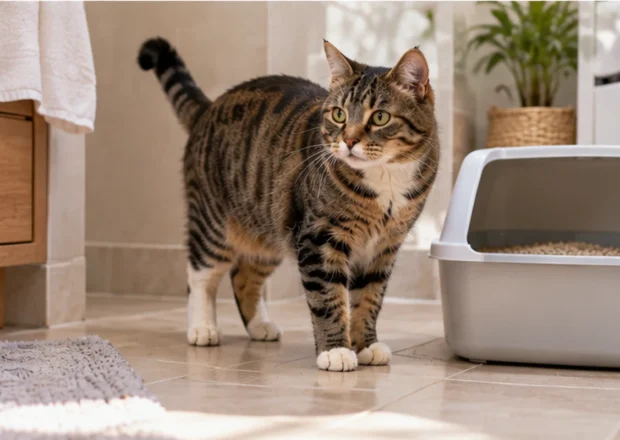
A litter box is a necessary environmental resource, not an object to hide wherever it is least visible to people. Cats need an accessible, clean place where they can use the box without being cornered, startled or blocked by another animal. Ohio State’s indoor-cat checklist emphasizes litter access and daily cleaning. In multi-cat homes, more than one box in separate useful locations may reduce competition. Boxes placed side by side do not always function as separate resources from a cat’s point of view.
Think through the route to each box. A timid cat may avoid a basement box if a dog sleeps at the stairs. An older cat may struggle to cross a large home or climb into a high-sided container. Avoid changing litter type, box position and cleaning schedule all at once without a reason; sudden changes make it difficult to determine what works. If a cat begins urinating or defecating outside the box, consult a veterinarian to consider medical causes. Punishment can increase stress and does not diagnose why the behavior changed.
Privacy and social choice matter
Cats need opportunities to withdraw from noise, visitors and other animals. A safe retreat might be an open carrier, covered bed, accessible room or elevated perch where household members agree not to disturb the cat. The critical feature is choice. A cat should not have to move past a barking dog or an assertive housemate to reach food, water or a resting area. In a multi-cat home, distribute resources across several locations rather than making every cat share one crowded station.
Respect a cat’s body language when offering attention. Voluntary approach, relaxed posture and the ability to leave can make interaction more comfortable than forced cuddling. When introducing environmental changes, retain familiar routes and resting sites where possible. A new cabinet, guest room setup or moving box may be more consequential to a cautious cat than you expect. Introduce new objects gradually and do not remove all familiar scent cues at once. Environmental stability is part of enrichment, especially during periods of household change.
Windows and the outdoors: stimulation without new hazards
A window perch can provide visual interest, but it needs a secure surface and a properly screened, closed window. A screen is not automatically strong enough to hold a cat leaning or jumping against it; check its condition and installation. Consider outside noise and whether seeing unfamiliar cats triggers stress for your own pet. A cat that becomes agitated by an outdoor visitor may be better off with a different view or partial visual barrier. More visual stimulation is not always better.
For households considering harness walking or an enclosed outdoor area, the plan should be based on the individual cat’s tolerance and safety. Never assume a cat accustomed to being indoors will enjoy being taken outside. Traffic, escape, parasites, weather and interaction with other animals are practical risks. Ask your veterinarian about preventive care relevant to the exposure. An indoor cat can have a fulfilling environment without unsupervised outdoor access, provided the household supports movement, rest, play and choice.
Build a low-cost, measurable plan
Begin with three improvements rather than redesigning the entire house. For example, place a stable perch where the cat already watches outside; move a scratcher beside a favored sleeping spot; and schedule two short, supervised play sessions at predictable times. Over the next two weeks, observe use and adjust. The time frame is an editorial example, not a medically validated treatment schedule. You can also rotate cardboard boxes for exploration if they have no staples, strings, hazardous residues or other unsafe parts.
Success is not measured by the price of the equipment or a photograph of the setup. Look for voluntary use, comfortable movement, normal eating and elimination, and a cat able to seek company or privacy. A lack of response may simply mean the particular item is uninteresting; it may also call for a health discussion if behavior changed substantially. Avoid solving every possible sign of distress with enrichment alone. Pain, illness and conflict among animals may require individualized professional assessment.
What to do when enrichment does not fix the problem
Environmental changes can improve choices, but they do not establish a diagnosis. A cat that suddenly hides, stops playing, eliminates outside the box or becomes aggressive may be experiencing pain, illness, stress or several factors together. Write down when the change started and what else changed in the household, then talk to a veterinarian. If the issue involves ongoing conflict or fear, a qualified behavior professional may work with the veterinary team. Do not postpone medical care because a new toy, pheromone product or scratching post has not had time to ‘work.’
Indoor enrichment is a continuing practice rather than a one-time shopping list. A kitten’s needs will evolve; an aging cat may need easier access; a household with a new baby or animal may need additional safe spaces. Reassess the setup whenever the home changes. The best design is one your cat can use confidently and that your household can maintain without creating new hazards. Small, well-placed choices often have more meaning than a room filled with novelty.
Research sources
- Ohio State Indoor Pet Initiative: Basic Indoor Cat Needs
- Ohio State Indoor Pet Initiative: Environmental Enrichment Resources
- Ohio State Indoor Pet Initiative: For Cat Owners
Research reviewed October 9, 2026. Changes in behavior or appetite can require veterinary evaluation rather than environmental changes alone.