The short answer: Introducing a new dog to a resident dog is a process, not a single nose-to-nose meeting. Start where neither dog has to defend familiar spaces, use one calm handler for each animal, maintain enough distance for relaxed walking and shorten or stop the interaction if either dog becomes stiff, fearful or highly aroused. At home, separate food, resting spaces and highly valued toys at first. Supervise every shared session and arrange a humane behavior professional’s help before attempting a risky introduction.
There is no promise that two dogs will become close friends. They may learn to coexist comfortably while preferring separate rest, play or human attention. That can be a successful outcome. A careful approach recognizes each dog’s history, medical status, body language and tolerance for proximity. Guidance from Humane World for Animals and Best Friends Animal Society favors neutral-area introductions and gradual, supervised contact, but individual safety concerns always take precedence over a generalized plan.
Decide whether the dogs should meet today
Before arranging a greeting, consider what you already know. Has either dog bitten another animal, repeatedly lunged at dogs on walks, guarded food or toys intensely, or shown panic when another dog approaches? Is one dog elderly, painful, recovering from surgery or easily overwhelmed? Does the prospective newcomer have unknown medical or vaccination history? These factors may change the order of events. An ordinary friendly-dog checklist is not a safe substitute for professional evaluation of a known bite risk.
A newly adopted dog may also be tired after transport, a shelter stay or a major change in routine. Rest and an initial veterinary care plan can be more urgent than meeting every animal in the household on arrival day. Consider whether you have the ability to provide genuinely separate spaces for days or longer if needed. Two dogs can live under one roof temporarily without having direct contact; a door or secure gate is a management tool, not a sign that the introduction has failed.
If you are adopting from a shelter or rescue, ask what staff have observed about dog-to-dog interactions. Specific observations matter more than broad labels such as ‘good with dogs.’ How close were the animals? Were there toys or food present? Did the dog disengage easily? A match that looked comfortable in a controlled assessment still requires caution in a different household.
Prepare people, equipment and the meeting location
Arrange a quiet neutral outdoor area with space to move away; avoid a crowded dog park where unfamiliar animals may rush into the introduction. Use properly fitted harnesses or collars and ordinary leashes that allow control without constant tight pulling. Each dog needs an attentive adult who can observe body language and change direction. Keep treats available if they are safe for the dogs, but do not scatter food between unfamiliar animals or create competition at close range.
Plan a short route with room for parallel walking. Agree in advance that either handler can call the meeting off with no argument. If you live alone and cannot safely manage both dogs, invite a competent helper or arrange a trainer. Trying to juggle two leashes and a camera while hoping the dogs work things out creates preventable risk. Bring water, waste bags and a phone, and check whether the area has unexpected off-leash activity.
Set up the house before you leave: separate comfortable resting areas, secure gates or doors, food and water stations, and a plan for which person will handle each dog after returning. Remove chews and toys that could spark resource guarding. Make sure children know not to open gates or encourage face-to-face greetings. The household plan matters as much as what happens on the first walk.
Start farther apart than you think you need
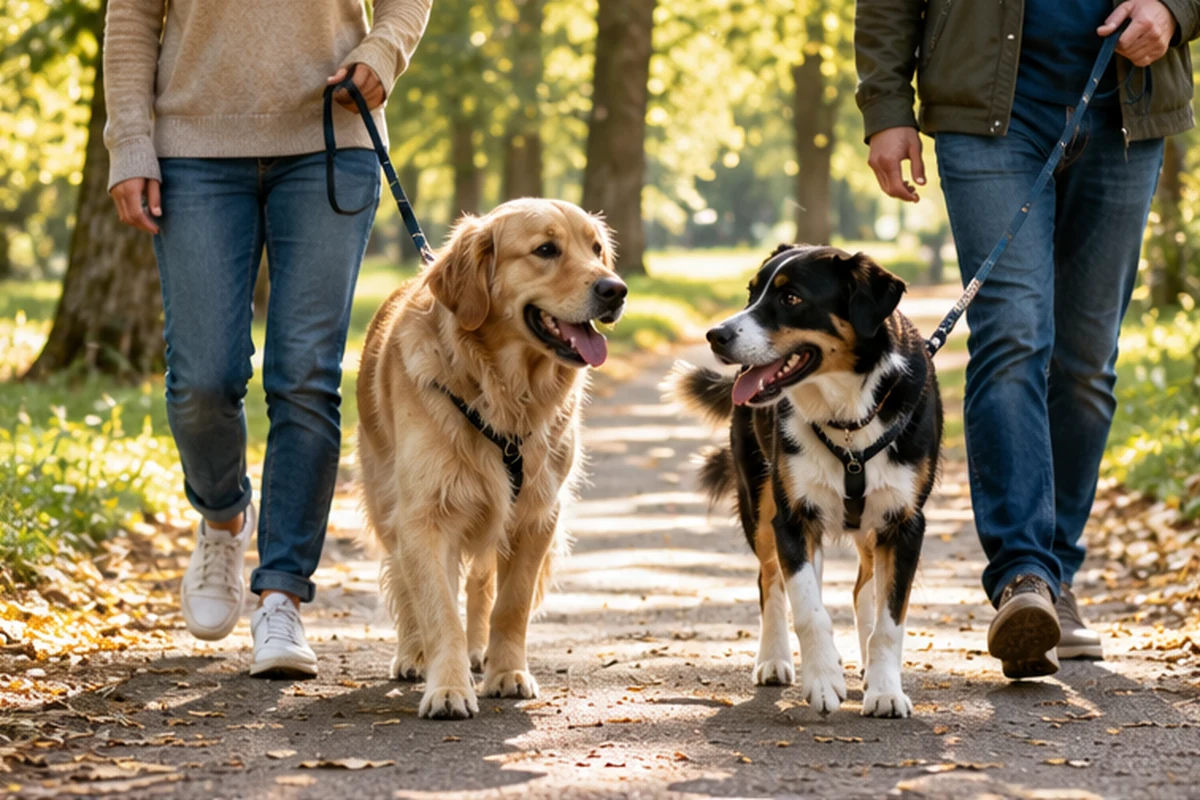
Begin with the dogs able to notice one another without being pulled into an interaction. They can walk in the same direction at a comfortable separation. Reward relaxed attention to handlers, curiosity that does not escalate and the ability to look away. Increase or decrease the distance according to what each dog actually does. An eager dog straining forward may be excited, frustrated, fearful or a mixture; eagerness alone does not establish readiness for direct greeting.
Look for loose movement, normal breathing, a willingness to sniff the environment and the capacity to respond to familiar cues. Watch for hard staring, stillness, freezing, high tension, repeated lunging, tucked posture, attempts to escape or growling. These are information. Do not punish growling: suppressing a warning without changing the situation can make the interaction less predictable. Increase distance and consider ending the session.
Progress is often non-linear. A dog may walk comfortably at twenty feet and become uneasy at ten. You can return to a comfortable distance, or simply try again another day. Dogs do not need a fixed number of minutes of contact to make the introduction ‘count.’ The priority is allowing successful, low-pressure experiences rather than rushing to a photograph of them sitting together.
When, if ever, allow a closer greeting?
If both dogs are showing consistently relaxed behavior on parallel walks, handlers can cautiously reduce the distance while remaining ready to move apart. A brief opportunity to sniff may be suitable for some dogs. Keep leashes loose where safe and avoid forcing a dog that turns away to return for another greeting. End a short successful interaction rather than pushing until one animal becomes uncomfortable. Several short positive sessions may be more useful than one extended visit.
Some dogs need a professional-led introduction because of size differences, excitement, prior incidents or complex body language. A muzzle may be part of a properly conditioned professional management plan but is not a license to force a close interaction or to ignore fearful signals. If you cannot maintain safe control of both dogs, do not attempt contact independently. A qualified trainer or veterinary behaviorist can assess the situation and develop the appropriate progression.
The common idea that dogs need to ‘sort out the hierarchy’ themselves is not a safety plan. Escalation can produce injuries and long-term fear. Humans are responsible for managing the environment, not merely standing back and hoping the animals settle a dispute. A successful first meeting often looks uneventful: two dogs notice each other, walk, disengage and finish without conflict.
The first day together at home
Do not march the new dog straight through the front door while the resident dog blocks the entry. Arrange access so each can move into its designated area without crowding. A well-secured barrier can provide visual contact at a distance; if watching through the gate produces barking or lunging, use a closed door or greater separation instead. Give the newcomer quiet time to explore one safe area before asking it to handle more social complexity.
Feed in separate rooms and pick up bowls afterward. Store high-value toys, chews and food puzzles unless you are providing them individually behind barriers. Keep sleeping places distinct and do not require dogs to share a bed or compete for a sofa. The goal is predictable access to resources. Even dogs that met pleasantly outdoors may respond differently when one approaches the other’s resting area or favorite person.
Supervision means an adult actively watching, not being elsewhere in the house. If you must take a call, shower or leave, separate the dogs. The exact length of the supervised period depends on their behavior and history, but trust should be earned through repeated calm interactions rather than assumed after the first day. Children should not be put in charge of mediating canine tension.
Play, roughness and when to interrupt
Play can include running, bouncing, role changes and vocalizing, but interpretation depends on the entire interaction. Look for pauses, mutual engagement and both dogs’ willingness to return. A smaller dog being chased continuously while attempting to hide is not necessarily having fun. If one dog pins, blocks or repeatedly overwhelms the other without allowing disengagement, calmly separate them and create a break. You do not need to wait for a fight before protecting space.
A fight is not an occasion to put your hands between dogs’ mouths or grab their collars without a safety plan. People can sustain serious bites. If there is an ongoing conflict, prioritize human safety, seek local emergency help or professional instructions for safe interruption, and arrange veterinary assessment for injuries. After an incident, keep animals separated and ask an appropriate professional whether future contact is advisable. Repeating the same setup immediately can intensify risk.
If a dog is unusually irritable, consider pain or illness as a possible contributor. Veterinary assessment can be relevant to a behavior change. A dog with sore joints may react defensively when jumped on even if it previously enjoyed rough play. Reducing stimulation and providing comfortable rest can be part of a broader plan while medical issues are addressed.
What a manageable first week can look like
A practical example—not a required schedule—is to focus day one on parallel walking and individual rest, then repeat distance-based walks over the next few days. If the dogs remain comfortable, add very brief supervised indoor time without toys or food. Keep individual routines intact: each dog still gets walks, quiet time and attention without competing for every resource. Progress only when both dogs recover calmly after sessions.
If one dog seems tense on day three, return to separate spaces and outdoor distance. This does not erase earlier progress. Watch for changes in eating, sleep, vocalization and the willingness to enter shared rooms. The newcomer may need a slower transition than the resident dog, or the resident may require more protected alone time. The household should adapt to the animal who is finding the process harder, rather than forcing the faster dog’s pace.
Write down specific events instead of labeling one animal ‘jealous.’ For example, ‘the older dog froze when the newcomer approached the sofa’ offers a trainer more useful information than ‘they hate each other.’ Videos filmed from a safe distance may help professionals assess patterns, but do not stage risky encounters just to record them.
When professional guidance is worth arranging
Seek a qualified force-free trainer or veterinary behaviorist if you see repeated lunging, inability to relax at a distance, guarding that threatens safety, previous bites, or escalating tension at barriers. A veterinary behaviorist can also address anxiety and pain-related contributors when needed. Ask about training methods, assessment approach and experience with multi-dog households. Avoid anyone promising a guaranteed friendship or relying on intimidation as a shortcut.
Professional input is especially important when a very large dog is paired with a much smaller or medically fragile companion. Even interactions intended as play can cause injury. If the placement was arranged through a rescue, ask about trial arrangements or support policies before a difficult situation turns dangerous. It can be kinder to acknowledge incompatibility than to impose ongoing chronic stress on both animals.
The useful definition of success
The goal is safe and comfortable coexistence, not instant affection. Some dogs eventually share naps and play; others prefer parallel walks and their own beds. Both outcomes can be entirely workable when household members respect boundaries. Keep separate resources available even after they appear settled and supervise situations that have previously caused tension. If uncertainty remains, choose separation and professional advice over taking unnecessary chances.
Research sources
- Humane World: Introducing Your New Dog to Your Other Dogs
- Best Friends: How to Introduce Dogs to Each Other
- ASPCA: Reward-based Training Position
Research reviewed October 9, 2026. Veterinary guidance is educational and not a diagnosis. Hypothetical calculations are not observed U.S. prices. Insurance terms, when discussed, depend on the current state-specific contract and the individual claim.