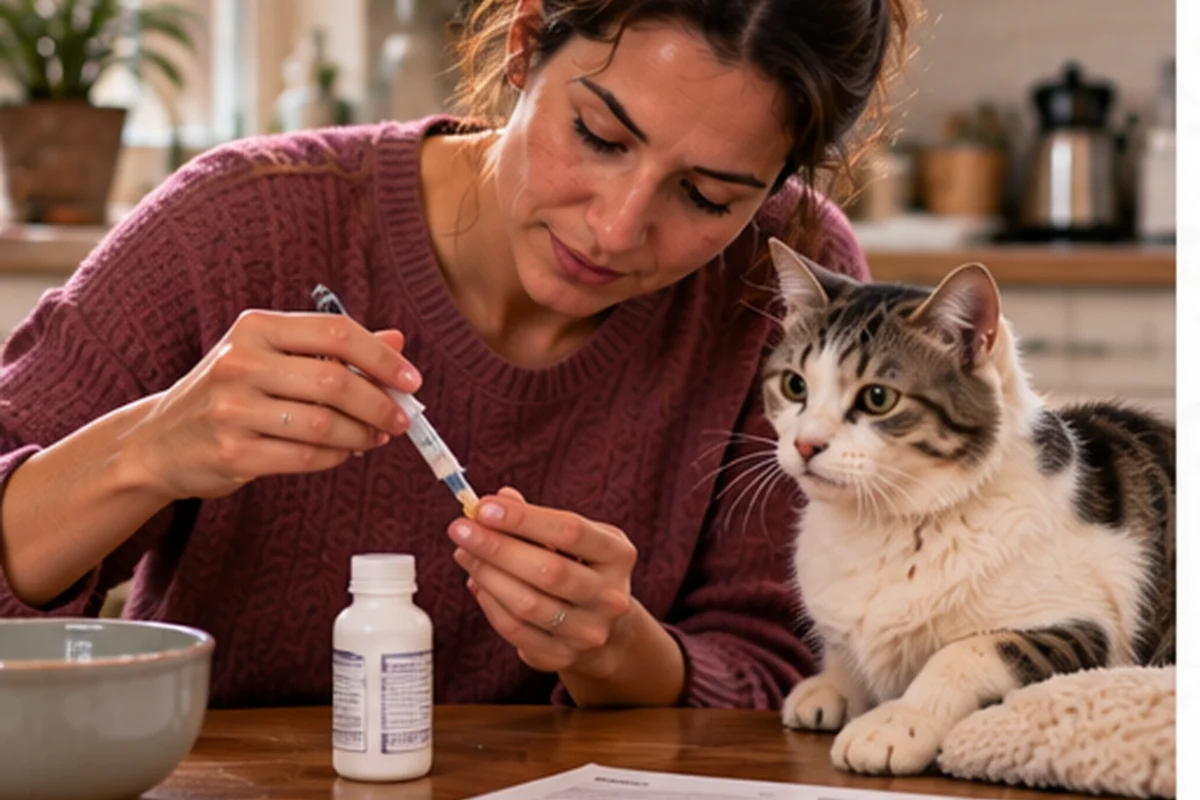
Giving a cat prescribed medicine safely starts before the first dose: confirm the exact drug, amount, schedule, route and whether it can be given with food. The veterinarian or pharmacist should demonstrate the technique for that specific product, especially when the cat resists handling. A pill, capsule, flavored liquid, ear preparation and transdermal medication are not interchangeable, and changing the form or crushing a tablet without approval can change how a medicine works.
Do not give human medicines or medications prescribed for another animal to your cat. Cats can be especially sensitive to drugs that people may regard as ordinary household remedies. If the cat has difficulty breathing, collapses, shows severe distress or appears to have a significant adverse reaction, contact an emergency veterinarian promptly. This article is about organizing safer home care, not choosing medicine or a dosage.
Check the prescription before you bring your cat over
Read the pharmacy label and compare it with the veterinarian’s written discharge instructions. Confirm which cat it belongs to, the prescribed amount, how often to administer it, and the treatment end date. When a household has several pets, store each animal’s medicine separately to avoid a mix-up. Some products need refrigeration or protection from light. Follow the dispensing label instead of assuming that all pet medicines can be kept in a bathroom cabinet.
Ask questions before giving the first dose: must the medicine be taken on an empty stomach, should food follow the tablet, and what should you do if the cat vomits immediately afterward? If two medicines are prescribed together, ask whether they should be separated. The answers depend on the particular drugs. A handwritten calendar or phone reminder helps with schedules, but neither replaces checking the label every time.
Prepare the space and supplies first
Cornell University’s veterinary pharmacy guidance emphasizes preparing pills or an oral syringe before handling the cat. Choose a quiet room with a stable surface and a clear path for your cat to leave after the procedure. Have the correctly measured medicine, a towel if recommended, treats when permitted, and any written instructions nearby. Do not open several unlabeled containers and rely on memory. If you use oral syringes, clearly separate them from devices for eye or ear medication.
The environment matters because many cats react more strongly when an owner is scrambling for supplies during restraint. Ask a family member to help only if both people can remain calm and have been shown what to do. A helper’s job is not to overpower the cat. If the animal is painful after surgery, anxious or medically fragile, the veterinary team may need to propose a gentler technique or different formulation.
Ask whether the medicine can go in food
Some prescriptions can be hidden in a small approved treat, but others should not be crushed, opened or mixed with a full meal. A veterinarian or pharmacist can confirm whether the product must remain intact, whether it interacts with particular foods and how to check that the complete dose was swallowed. Mixing an unpleasant medicine into the usual food may also make the cat distrust that food, especially if the taste or smell changes.
If mixing is permitted, use a tiny portion of food you can observe the cat finishing before offering the rest of its meal. Hiding medicine in a large bowl creates uncertainty when food remains. If your cat refuses the treat, do not keep increasing the amount of medicine-laced food without checking with the clinic. A different flavor, a compounded formulation or another route may be possible, but the prescribing professional must approve the change.
Pill administration should be demonstrated, not improvised
Cornell and the Merck Veterinary Manual describe direct oral administration of tablets and capsules, including careful head positioning and gentle opening of the mouth. Technique and safety depend on the animal, the product and the handler. Ask the veterinary nurse or veterinarian to show the position in person, then practice with guidance if needed. Do not force a pill into a cat that is struggling to breathe or bite forcefully; this creates risk for both animal and person.
Confirm whether the medication requires water or food after swallowing. Some tablets and capsules can irritate the esophagus if they remain lodged, but the exact follow-up differs by product and patient. Do not squirt fluid into a distressed cat’s mouth as a substitute for instruction. Instead, ask the clinic how to encourage swallowing safely and what to do if a tablet was partly spat out or seems stuck.
Liquid medicine requires special care
A dosing syringe should display the units prescribed, and the owner should know the difference between milliliters and any markings on the device. Measure the correct volume before approaching the cat. Cornell advises placing the oral syringe at the side of the mouth and giving small amounts gradually, allowing swallowing rather than sending a forceful stream into the throat. Excessively rapid delivery risks choking or aspiration, particularly when the animal is resisting.
If the liquid spills or the cat spits some out, the dose received may be uncertain. Do not automatically repeat the full dose: doing so could provide too much. Contact the prescribing clinic and describe what happened. Similarly, a cat that coughs, gags or shows abnormal breathing during administration needs prompt assessment. A technique that seems successful because the syringe is empty is not necessarily safe or effective.
Eye, ear and skin products have their own rules
Eye drops, ear treatments and topical or transdermal products require product-specific directions. An eye medication should never be confused with an ear solution merely because both containers are small. Cornell’s clinical guidance advises careful handling of multiple eye medication caps to avoid mixing them. Ask whether the bottle tip must avoid touching the eye or skin and how long to wait between products. Do not touch applicators to dirty surfaces, then return them to a container.
For ear medications, the veterinary team may need to show how far to position an applicator, what discharge or discomfort should prompt a call and whether cleaning is required beforehand. For skin-applied products, ask where the medicine belongs and whether children or other pets should avoid contact until it is absorbed. An owner’s confidence with pills does not automatically translate to a different route.
Make restraint cooperative whenever possible
Short, positive handling sessions outside medication time can improve tolerance. Practice touching the head, lifting a lip or approaching with an empty syringe only while the cat remains comfortable, rewarding afterward if medically appropriate. Allow the cat to leave between practice repetitions. If the cat stops taking treats, crouches, hisses or tries to flee, the session may have progressed too far. Returning to an easier action is more useful than escalating pressure.
Some cats need a towel wrap or another controlled handling technique, but this must be learned safely and should not restrict breathing or worsen painful conditions. Ask a veterinary professional to demonstrate. Do not scruff, squeeze or pin a struggling cat by default. The goal is reliable treatment with minimal fear, not completing a chore by any means available.
What if the cat refuses every attempt?
Call the prescribing veterinarian early instead of allowing several doses to pass without discussion. Explain which method you attempted, what the cat did and whether any medication was swallowed. The clinic may be able to demonstrate a safer technique, prescribe a different formulation or adjust the treatment plan if clinically appropriate. Some drugs are available in flavored oral liquids or alternative forms, but those options cannot be presumed equivalent for the particular condition.
Do not put medicine into a shared food bowl when there are multiple cats, and do not leave medicated food unattended where the wrong animal could eat it. If you cannot give the medicine safely, document the missed dose and ask the clinic for a specific plan. The consequences of missed doses vary widely; an owner should not guess which treatments can be skipped or doubled.
Missed doses, vomiting and uncertain swallowing
Before treatment begins, request written guidance about common problems. If a dose is late, should it be given when remembered or skipped? What if the cat vomits 10 minutes later? What if part of a crushed tablet remains on a plate? The correct answer can differ with the medicine, treatment goal, schedule and patient. Double-dosing to ‘catch up’ without permission can be hazardous.
A medication record should include the actual time administered, dose confirmed, observations and the person responsible. This prevents two family members from independently giving what they both believe is the scheduled dose. Keep a separate note of vomiting, stool changes, appetite or unusual behavior. A log is particularly valuable if the veterinarian needs to evaluate whether symptoms are caused by the underlying disease, treatment or another problem.
Side effects and when to contact the veterinarian
Ask the clinic which effects are expected, which warrant a call during office hours and which need emergency care. Some medicines can cause mild temporary changes, while others have potentially serious reactions. Do not diagnose a side effect from a single online symptom list. Record when the signs appeared in relation to the dose, and note whether your cat is drinking, eating and behaving normally.
Contact a veterinarian promptly if your cat repeatedly vomits after doses, refuses food, shows marked lethargy or appears painful. Seek emergency care for breathing difficulty, collapse, severe neurological abnormalities or rapidly worsening distress. Bring the packaging or a photo of the label to the clinic so staff can identify exactly what the cat received. Do not wait to complete an online medication guide if the animal is critically ill.
Keep medicines away from pets and children
Store all medication in a secure place with readable original labels. Cats may play with tablets left on a table, and a dropped human medication can be dangerous. Cornell’s feline safety guidance specifically warns against giving cats household human pain relievers without veterinary direction. Do not transfer pills into anonymous jars to make storage look tidy. Moisture, temperature and light can also affect some products, making label directions important.
When traveling or sending a cat to a sitter, provide the medicine in its original packaging, a written schedule, the veterinarian’s number and clear instructions about what to do when a dose cannot be given. Do not instruct a sitter to repeat a disputed dose or change the route. If treatment is complex, arrange a demonstration and confirm that the person can perform it safely before the owner leaves.
A practical medication schedule
For example, imagine a cat prescribed two different oral medicines with different timings. Create two separate rows: one for the morning drug, one for the evening drug, each listing label directions, person administering, time given and any observations. If a third family member takes over, the log should show what has already happened. This is an organizational example only; it does not suggest a schedule for any actual drug.
Review the chart during follow-up appointments and report any missed or partially administered doses. Keep prescription refill dates separate from the end-of-treatment date. For long-term conditions, ask whether regular blood tests, weight checks or other monitoring are part of safe treatment. Those additional steps may matter as much as the daily act of giving the medicine.
What to do before the next dose
Confirm the label, prepare the supplies, make sure the cat is breathing and behaving normally, and follow the technique demonstrated by your veterinary team. If your cat becomes frightened or the dose is uncertain, contact the clinic rather than improvising. Safe medication care is a combination of the right prescription, correct administration, accurate records and willingness to ask for help. Protecting that routine is more important than finding a trick that works once but causes greater fear the next day.
Research sources
Original sources reviewed October 10, 2026. Health content is educational and requires qualified clinical review; insurer products vary by state and policy form.