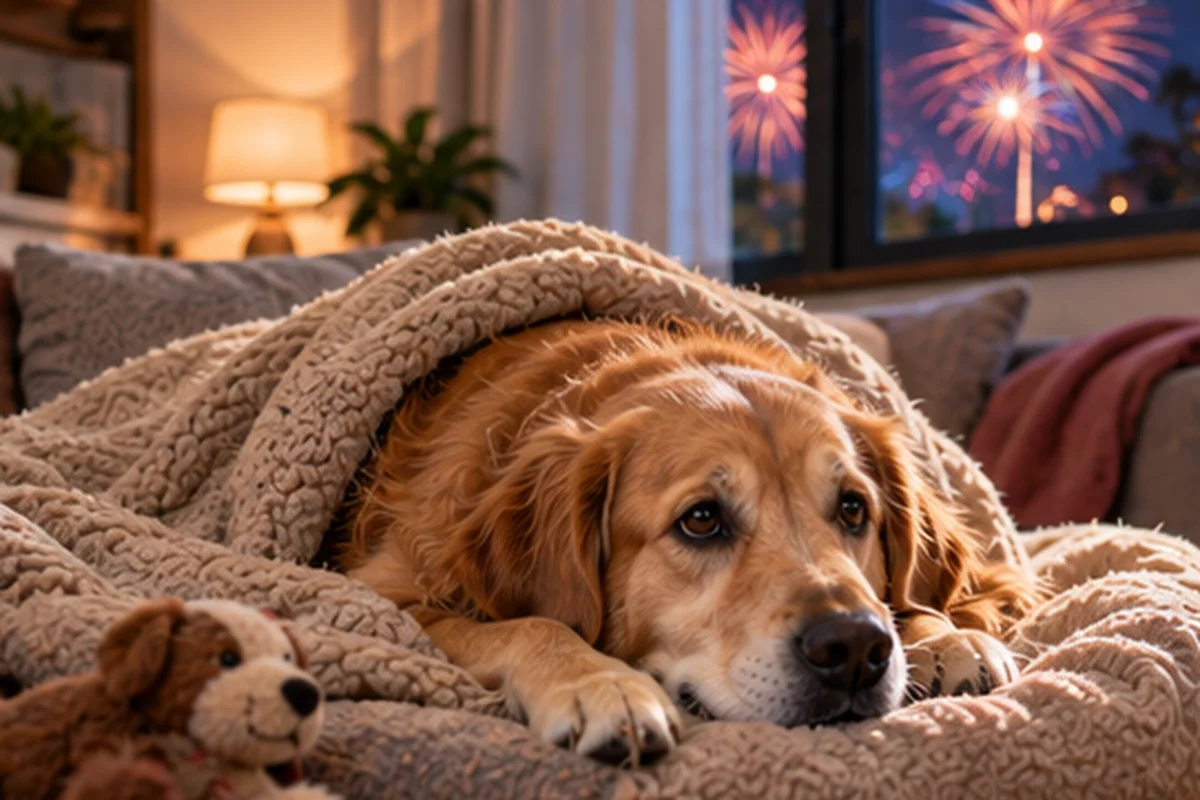
A dog who shakes, hides, pants, paces or tries to escape during fireworks is showing distress, not being stubborn. The safest immediate response is to prevent escape, offer a quiet place and avoid forcing the dog to face the noise. For a dog with a history of panic, speak with a veterinarian well before the next expected fireworks event; treatment may combine environmental changes, carefully planned training and, when appropriate, prescription medication. A dramatic reaction or an escape attempt also calls for urgent attention to physical safety.
Fireworks fear is not solved by telling a dog that nothing is wrong. The sounds are unpredictable, often accompanied by vibration and flashes, and may be much more intense to the animal than the family realizes. Owners can make meaningful progress, but the plan must change with the dog’s actual response. This guide concentrates on what to do at different points in the calendar and how to avoid well-intentioned mistakes that make a frightened dog less safe.
First, identify what fear looks like in your dog
Not every fearful dog barks. Some freeze, become unusually clingy, hide behind furniture, refuse favorite treats, salivate, shake or repeatedly scan the room. Others scratch doors, pace, run away or try to leap a fence. A dog may start anticipating fireworks after previous frightening experiences; some become reactive to other bangs or thunderstorms, too. The important question is whether the pet can settle and recover, not how noisy the behavior looks to human observers.
Write down the setting of the last incident, approximately when it began, the strongest signs, whether your dog ate or drank normally and what helped. Note possible injuries caused by frantic escape attempts. A brief video, taken only if it does not interfere with your dog's safety, can help a veterinarian judge severity. Avoid assuming fear always has a behavioral cause; pain, changing hearing and other medical problems can influence how a dog tolerates a once-familiar environment.
Set up the home before anyone lights a firework
Choose a room where outside sound and flashes can be softened. Close windows and curtains, provide water and bedding, and consider a familiar fan or moderate background audio. Make it easy for the dog to enter and leave a chosen resting spot. VCA's veterinary behavior guidance notes that crates can comfort some dogs, but confining a dog who panics inside a crate can cause injury. Do not introduce confinement on the night you need it to work.
Check doors, screens, gates and fences in advance. A dog startled by a boom may move unpredictably even if they normally respond to recall. Attach updated identification to a properly fitting collar and make sure microchip contact details are current. Take a walk and allow a toilet break before planned local celebrations, keeping the dog on an appropriate leash. If you need to go outside during the event, use equipment you can control securely; one loose door can undo otherwise careful preparation.
What to do during the event
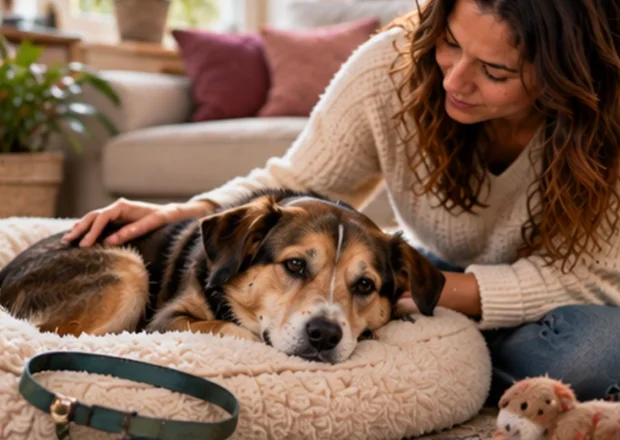
Stay calm and available. Allow your dog to choose whether to lie near you, retreat to another room or use a familiar covered space. Gentle reassurance is not the same as forcing affection: if the dog leans into your presence, you can offer quiet company, but avoid restraining one that tries to leave. Some dogs will take a food puzzle; others are too distressed to eat. Refusing food during a frightening event is a useful signal that a training session is not going to succeed at that moment.
Do not punish barking, trembling or hiding. Do not drag a frightened animal to a window 'to show there is no danger,' and do not turn on loud recordings hoping to drown out the fireworks. A household member should remain responsible for the dog if visitors are entering or leaving. Where possible, notify guests ahead of time that doors must be closed. The immediate objective is welfare and prevention of escape, not teaching a lesson while the animal is overwhelmed.
Escape attempts are a safety issue, not just a training issue
Dogs who chew barriers, scrape at windows or throw themselves against gates can be injured. If your dog tries to break out, move to a safer environment and call your veterinarian or emergency service for advice when injury or severe distress is present. A dog who has escaped may be difficult to call back while frightened. Have recent photographs, identification information and a local shelter contact list available rather than waiting until a crisis to assemble them.
Consider whether the home layout itself needs modification: a second door or temporary baby gate may reduce the chance of a direct dash outdoors. A familiar safe room with an interior door may be better than a noisy room overlooking a display. Do not leave a severe panic case unattended for hours just because the animal was placed in a 'calming' garment. Safety measures help contain risk, but they do not replace assessment and treatment of intense fear.
When to involve a veterinarian or veterinary behavior professional
Book a consultation if your dog routinely panics, struggles to recover, injures itself, stops functioning normally during storms or becomes distressed by progressively smaller triggers. Explain the behavior rather than merely asking for a sedative. The veterinarian may look for physical problems and discuss evidence-based anxiety management. Some dogs benefit from medication given before predictable events; others may need a longer-term treatment plan. Only the prescribing veterinarian can advise whether a medication is suitable and how to use it.
Never give human sleeping pills, leftover prescriptions or a friend's dog's anxiety medication. Products sold as 'natural calming' aids can interact with other drugs or have limited evidence for particular animals. If the dog is already severely distressed when a celebration starts, call the clinic to ask what options are safe rather than improvising with extra doses. A medication that causes drowsiness does not necessarily eliminate fear, which is another reason professional guidance matters.
Teach a relaxation routine before the next event
During quiet weeks, identify a location your dog already likes. Reward relaxed posture and voluntary settling there. Short, predictable sessions with a favorite treat or toy can establish the room as a pleasant destination. This is preparation, not obedience punishment: stop if the dog becomes tense or leaves repeatedly. Some families find a portable mat useful because it lets the resting routine move between rooms or homes, but the dog should never be forced to stay on it.
Once your dog reliably relaxes without a trigger, a veterinarian or qualified behavior professional may advise controlled exposure to recorded sounds at a level that does not provoke fear. Sound recordings are imperfect copies of actual fireworks, and abrupt or loud exposure can backfire. Do not try to 'flood' the dog with a full-volume display until it stops reacting; apparent stillness can also mean the animal is overwhelmed. Progress should be judged by genuinely relaxed body language, not by silence alone.
Counterconditioning works only below the fear threshold
Counterconditioning aims to change the association around a stimulus through pleasant outcomes. For example, at a low and tolerable level, a distant recorded noise may predict a small treat. If the dog tenses, refuses food, pants or scans for escape, the exposure is too strong. Reduce the difficulty or end the session. Repeated successes at an easy level matter more than reaching a particular volume on the speaker.
Training should also account for the dog's health, age and preferences. A dog with arthritis may not enjoy being asked to jump onto a mat; an older animal with hearing changes may react differently than a young puppy. Owners should keep training plans realistic when the next holiday is close. If fireworks may occur within days, concentrate on environmental safety and veterinary advice first. Long-term desensitization usually deserves a calmer period when the family can control exposure.
A timeline for households with predictable celebrations
Several weeks ahead, check microchip registration and tags, arrange a veterinary behavior discussion if your dog has a serious history, and begin comfortable settling practice. About a week ahead, confirm where the animal will stay and who will be home. In the days before the event, keep ordinary exercise and meals consistent; sudden changes in routine can add stress. On the afternoon of a celebration, close windows, prepare the chosen room and complete outdoor walks early.
During the fireworks, watch for escalating fear instead of rigidly following a schedule. If the dog is comfortable, you do not need to perform a complicated series of distractions. Afterward, inspect for injuries, check appetite and hydration and note how long recovery took. The next day can be an appropriate time to contact the veterinarian about whether the plan worked and what could improve before another event.
Fireworks and puppies: avoid the first bad experience
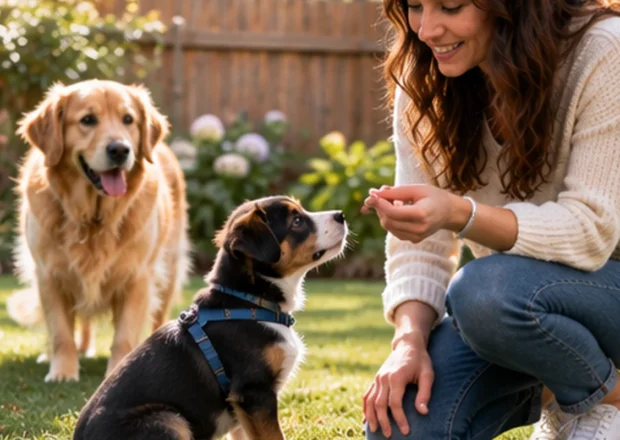
A puppy's lack of response to one distant bang does not guarantee resilience to a nearby firework. Offer controlled, positive everyday experiences rather than taking a puppy to a crowded fireworks show for 'socialization.' A fenced yard may still be unsafe if a sudden display begins and gates are open. Young dogs need gradual exposure to people, sights and sounds that they can tolerate; flooding a puppy with unpredictable noise is not a shortcut to confidence.
If your puppy becomes frightened, create distance from the trigger and give it an opportunity to settle. Make a note of what happened and discuss persistent or unusually intense reactions with the veterinarian. The goal is not to manufacture a fearless dog. It is to help a developing animal trust the household as a safe place and to build practical routines that reduce future stress.
What a calming product can and cannot promise
Pressure garments, pheromone diffusers, music and food puzzles may be supportive for some animals. Their effect varies, and a product that helps mild nervousness might not be enough for a dog who tries to break through a door. Test any wearable item before the event, check fit and make sure it does not trap heat or restrict movement. A dog should be supervised with new products until its response is clear.
Treat online 'works for every dog' testimonials cautiously. A family needs to know whether the dog actually relaxed, whether escape risk decreased and whether there were side effects. Record what changed, including what did not. Avoid combining several supplements and medications without professional advice: doing many things at once makes it harder to understand benefit, harms or interactions.
When a dog is distressed and you cannot stay home
If possible, arrange for a trusted person who already knows the dog to remain nearby or choose a quiet location away from the display. Boarding somewhere unfamiliar at the last minute may add stress, so discuss the option early and consider the dog's actual past reactions. Provide clear instructions about doors, medication prescribed by your veterinarian, and emergency contacts. Anyone caring for your dog should understand that a panicking animal must not be walked off leash, even in a familiar field.
If no responsible supervision is possible and the dog has a serious history of escape attempts or injury, ask the veterinary team about safer contingency plans. An empty house, a new crate and an untested supplement are not a reliable treatment strategy. Preparation should reduce the burden on the animal as well as on whoever is caring for it.
What to do after a difficult night
A frightened dog may be tired, clingy or reluctant to go outside afterward. Offer familiar routines and a calm place to rest. If the dog was injured, shows persistent breathing difficulty, extreme weakness or another concerning sign, seek veterinary care. Recheck doors and fencing, and document any escape attempts, even if unsuccessful. Those details determine how urgent a new prevention plan is.
The most useful next step is usually a brief debrief: what frightened the dog, what made it safer and what remained difficult? With that information, the family and veterinarian can plan for the next fireworks event. Successful care is not measured by whether the dog watched a display quietly. It is measured by whether fear was reduced and the dog stayed safe.
Research sources
Research checked October 10, 2026. Sources support the medical, consumer or policy background; illustrative budgets and editorial interpretations are identified in the article.